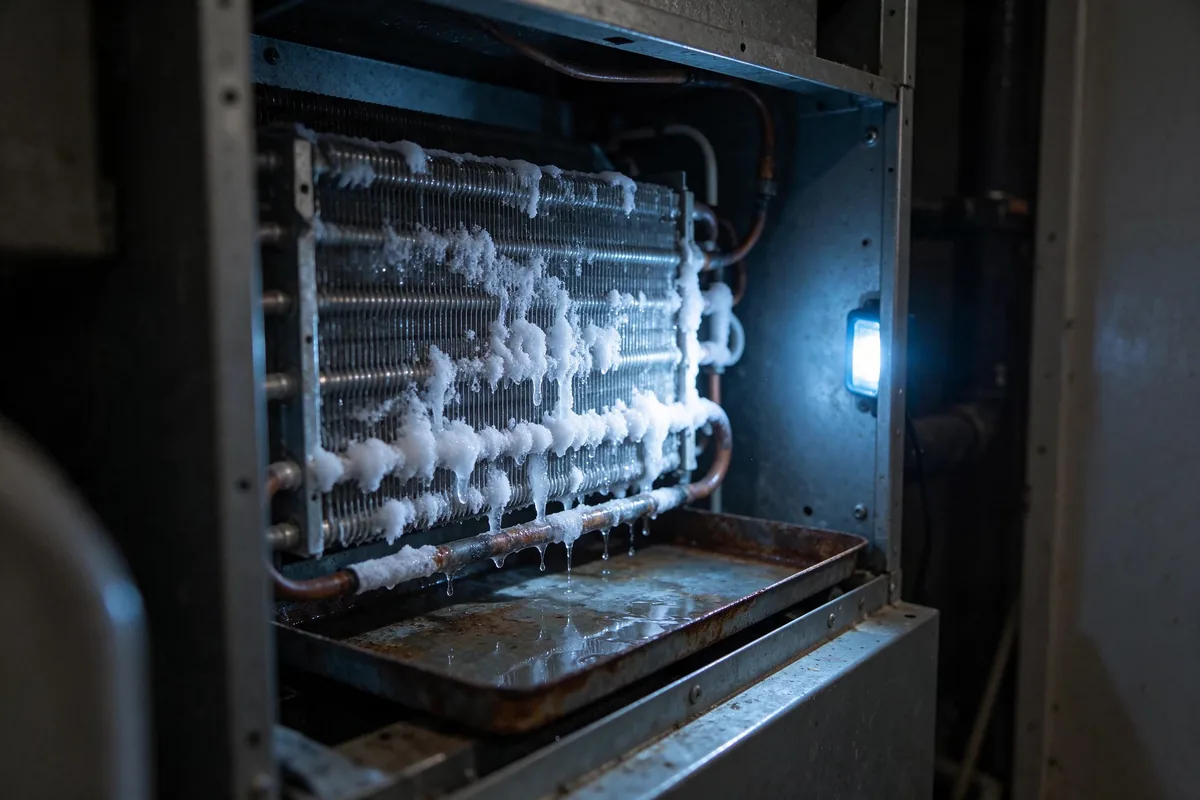
Denver summers are dry enough that an air conditioner can run for weeks without anyone noticing a problem, right up until the day it stops cooling and the technician finds a block of ice where the coil should be. Ice is one of the few failures homeowners can see directly, and it is also one of the most misread. It looks like a refrigeration fault. Most of the time it is an airflow fault.
The reason is simple physics. The evaporator coil absorbs heat from the air moving across it. If that air is restricted, the coil gets colder than it should, condenses more water than it can drain, and eventually drops below freezing. The ice is a symptom of the coil being starved of warm air, not of the refrigerant being wrong — although low charge can produce the same result by lowering coil pressure and temperature.
Ice is a symptom, not the diagnosis
When we arrive at a frozen system, the first step is not to add refrigerant. It is to turn the system off, let the coil thaw completely, and then measure. A coil that is still iced cannot be diagnosed accurately: pressures read low, superheat reads strange, and airflow is blocked by the ice itself. Thawing takes time, and rushing it is how systems get misdiagnosed and overcharged.
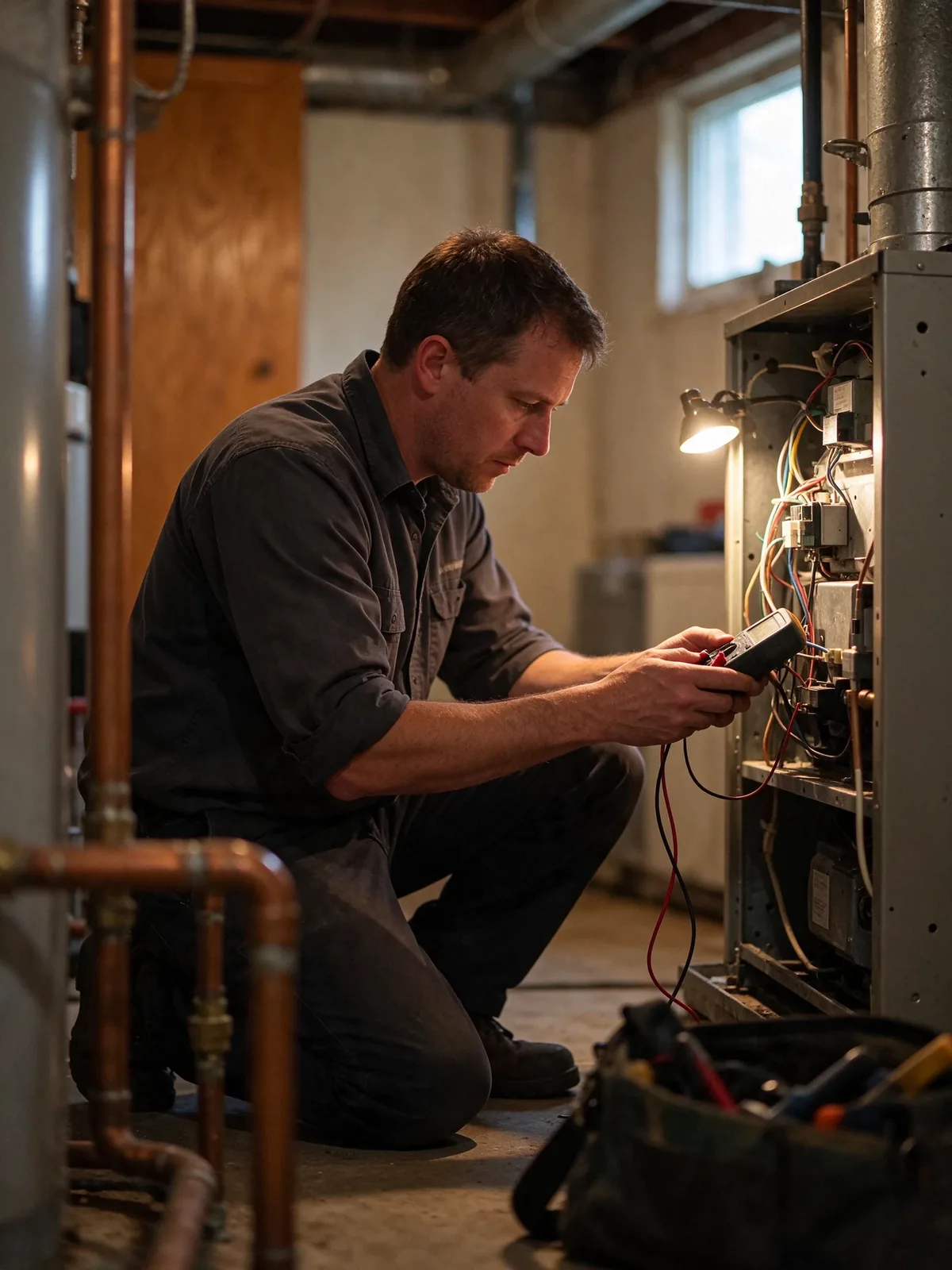
Once the coil is clear, the diagnosis becomes a sequence of measurements rather than a guess. Return air temperature, supply air temperature, static pressure across the coil and filter, and superheat or subcooling depending on the metering device. Each number narrows the list. A coil that ices at a normal charge with high static pressure is an airflow problem. A coil that ices with low suction pressure and high superheat is undercharged or restricted at the metering device.
Airflow comes first, always
In Denver homes, restricted airflow is the most common cause of freezing, and the causes are ordinary. A filter that has not been changed since spring. A return grille covered by a rug or a bookshelf. A evaporator coil that has collected a mat of dust and pet hair on the underside, invisible unless you remove the panel and look with a light. A duct run that was crushed during a basement remodel. A blower wheel loaded with debris so the fan moves less air than its rating suggests.
The static pressure test tells you which of these is happening before you take anything apart. We measure pressure drop across the filter, across the coil, and across the supply and return ducts. A system designed for 0.5 inches of water column total is often running at twice that in older Denver homes, and the coil pays the price. Correcting the restriction — a deeper filter cabinet, a cleaned coil, a repaired duct — fixes the freezing without touching the refrigerant circuit.
When it really is the charge
Low refrigerant charge produces the same ice for a different reason: lower pressure means a lower coil temperature. A system that is slightly low will freeze on hot days when it runs continuously, then seem fine on milder days. That pattern — freezing only during the hottest stretch — is a useful clue, because it points to charge or a restriction rather than a filter.
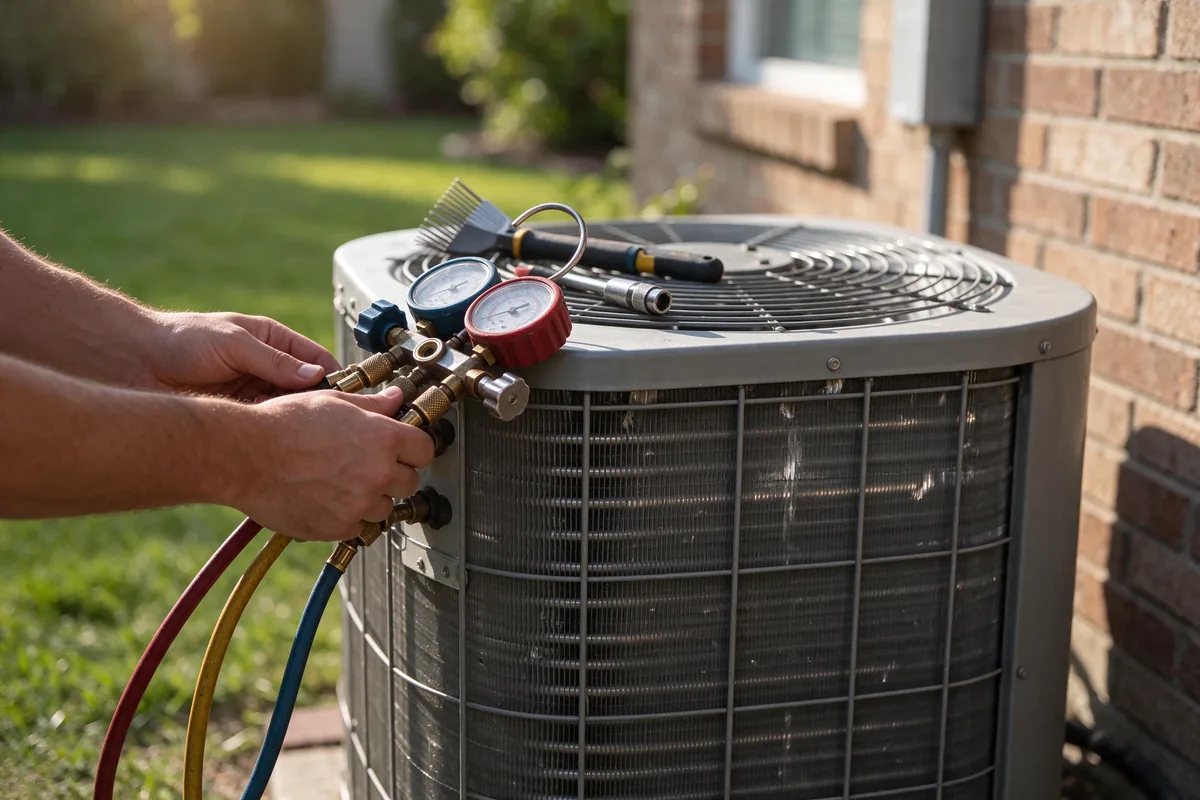
Leaks are the usual cause, and they do not fix themselves. Adding refrigerant without finding the leak buys a season at best. We pressure test, locate the leak at the common points — Schrader ports, brazed joints, coil end plates — and repair or replace the affected component before recharging to the manufacturer's specified subcooling or superheat.
What to do before we arrive
- Turn the system off at the thermostat. Running a frozen unit can damage the compressor.
- Replace the filter, even if it looks only partly loaded.
- Clear anything blocking return grilles, including furniture and rugs.
- Check that the outdoor unit has two feet of clear space and a clean coil.
- Note when it freezes: all day, only afternoons, or only on the hottest days.
That last note is more useful than it sounds. A system that freezes every afternoon at four o'clock is telling you something different from one that freezes at midnight. The pattern, the filter history and the static pressure numbers together usually identify the cause on the first visit rather than the third.
Prevention is mostly maintenance
A coil that is cleaned annually, a filter that is changed on schedule and a duct system that is not restricted will not freeze. The systems we see freezing repeatedly are almost always the ones where maintenance was skipped for several seasons. A spring visit that includes coil cleaning, a static pressure check and a drain flush costs far less than a compressor replacement in August.
Denver's dry air also means the condensate drain matters more than people expect. A drain that is partly clogged will back water into the pan, and a pan that rusts through leaks into the ceiling below. We flush drains at every service visit because the failure is cheap to prevent and expensive to repair.
The drain line nobody checks
A frozen coil melts into the drain pan, and the pan has to carry that water somewhere. In Denver homes the drain often runs to a floor drain, a condensate pump or a hole in the foundation wall, and any of those can clog with the algae and dust that accumulate over a season. When the drain stops, the pan fills, and the overflow lands in the ceiling below or on the furnace's control board.
We flush every drain at every cooling service because the failure is entirely preventable and the repair is not cheap. A float switch installed in the pan is a small addition that shuts the system down before water reaches drywall. If your system has overflowed once, that switch should already be there.