Furnaces are communicative machines. They hum, click, whistle, smell and cycle in patterns, and most of those patterns map to a specific component. The problem is that homeowners hear the symptom without the map, so a whistle that means "restricted filter" gets treated like a noise to ignore until something fails in January.
What follows is the map we use on service calls: the common signals, what they usually indicate, and which ones mean turn the system off and call rather than wait and see.
Smells, in order of urgency
A burning dust smell on the first cold day of the season is normal. It is dust on the heat exchanger burning off, and it fades within an hour. A metallic or oily smell that persists is not normal and suggests an electrical component overheating or a motor failing. A rotten egg smell means a gas leak, and the correct response is to leave the house and call from outside — not to investigate.
Exhaust smells are the most serious category. If you smell combustion gas inside the house, or if a carbon monoxide alarm sounds, shut the system down, ventilate and call. A cracked heat exchanger or a blocked flue can push exhaust into the supply air, and no amount of filter changing addresses it.
Whistles and whooshes are pressure
A whistle is air moving through a restriction. The usual suspects are a filter that is loaded, a return grille that is too small, a duct joint that has separated, or a blower wheel with debris on the blades changing the airflow pattern. A whoosh at the register when the blower starts is often a duct that is undersized for the equipment, which is a design issue rather than a failure.
Pressure problems are worth chasing because they are not just noise. A system running at high static pressure moves less air, runs hotter, and wears out blower motors early. The whistle is the audible part of a problem that also costs efficiency.
Short cycling has several causes
A furnace that starts, runs for two or three minutes and shuts down is short cycling, and the cause could be on either side of the heat exchanger. On the combustion side: a dirty flame sensor, a failing igniter, a blocked pressure switch port, a flue that is restricted. On the air side: a filter so loaded that the high-limit switch trips, or a blower that is failing to move enough air.
The pattern narrows it. If it shuts down before the blower ever comes on, the problem is in ignition or draft proving. If it runs for several minutes and then shuts off with the blower still running, the high-limit switch is likely opening because of restricted airflow or a failing blower. Those are different repairs, and guessing between them wastes parts.
Flame color tells you something real
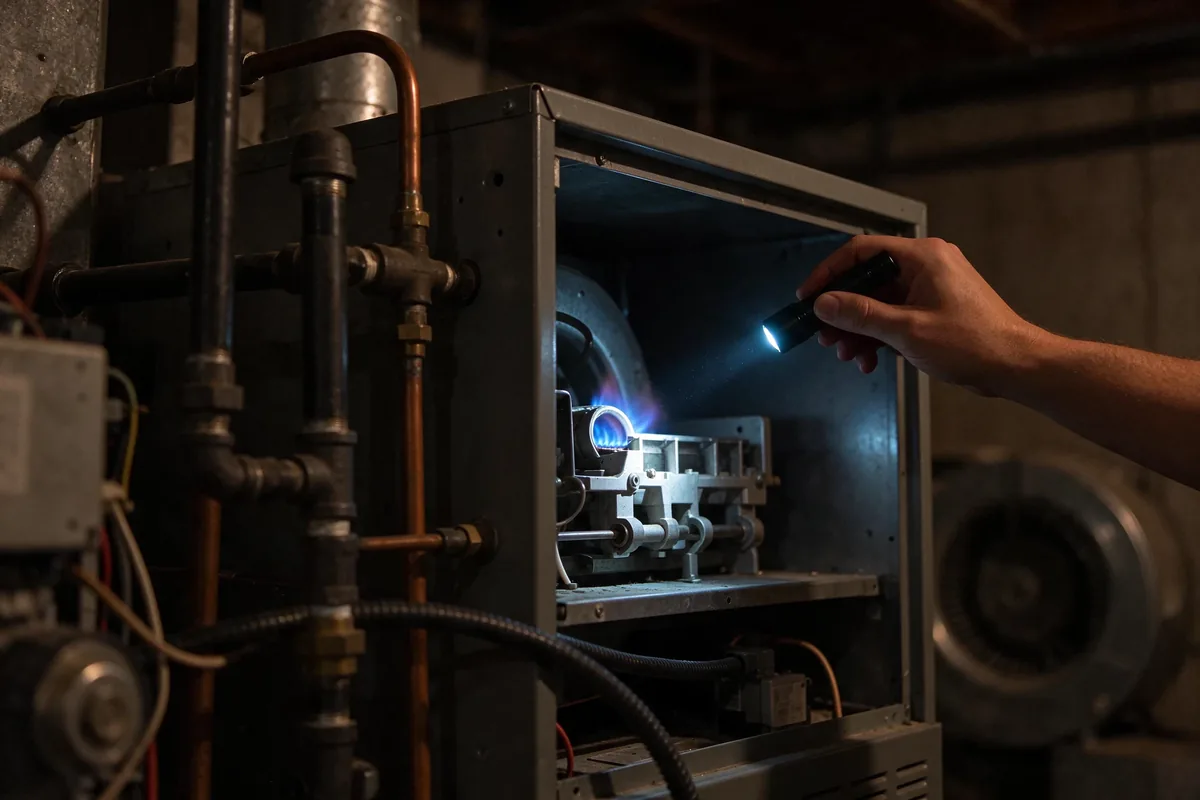
A healthy gas flame is blue with a small, steady inner cone. A yellow, lazy or lifting flame suggests incomplete combustion, which can be caused by dirty burners, incorrect gas pressure, or a lack of combustion air. This is a combustion analysis item, not a visual guess, but the color is a reasonable reason to schedule service.
What to check before calling
- Replace the filter and see whether the whistle or short cycle changes.
- Confirm the thermostat is not set to a schedule that is fighting you.
- Check that the return grilles are clear and the registers are open.
- Look at the flue and the outdoor vent termination for blockage or ice.
- Write down the pattern: how long it runs, how long it rests, and what it sounds like.
That written pattern is worth more than a description over the phone. "It runs three minutes and shuts off, then tries again after five" points at a high-limit trip. "It clicks and never lights" points at ignition. The difference determines what parts the technician brings and whether the visit is a repair or a diagnostic.
The signals that mean stop
Any gas smell, any combustion smell indoors, any carbon monoxide alarm, or a flame that rolls out of the burner compartment are reasons to shut the system off at the switch and call. Those are not maintenance items and they do not improve with time. Everything else on this list can wait for a scheduled visit, but it should not wait for a failure.
The maintenance that prevents most of this
Almost every symptom in this note traces back to something a seasonal visit would have caught: a filter that was never changed, a flame sensor that was never cleaned, a drain trap that was never flushed, a blower wheel that was never inspected. None of those are difficult tasks. They are simply tasks nobody thinks about until the heat stops.
A fall visit takes under an hour for most homes and covers combustion, airflow, drainage and controls. The value is not the cleaning itself; it is the measurement that says whether the system will hold through a January cold snap, and the small correction that prevents a weekend call.